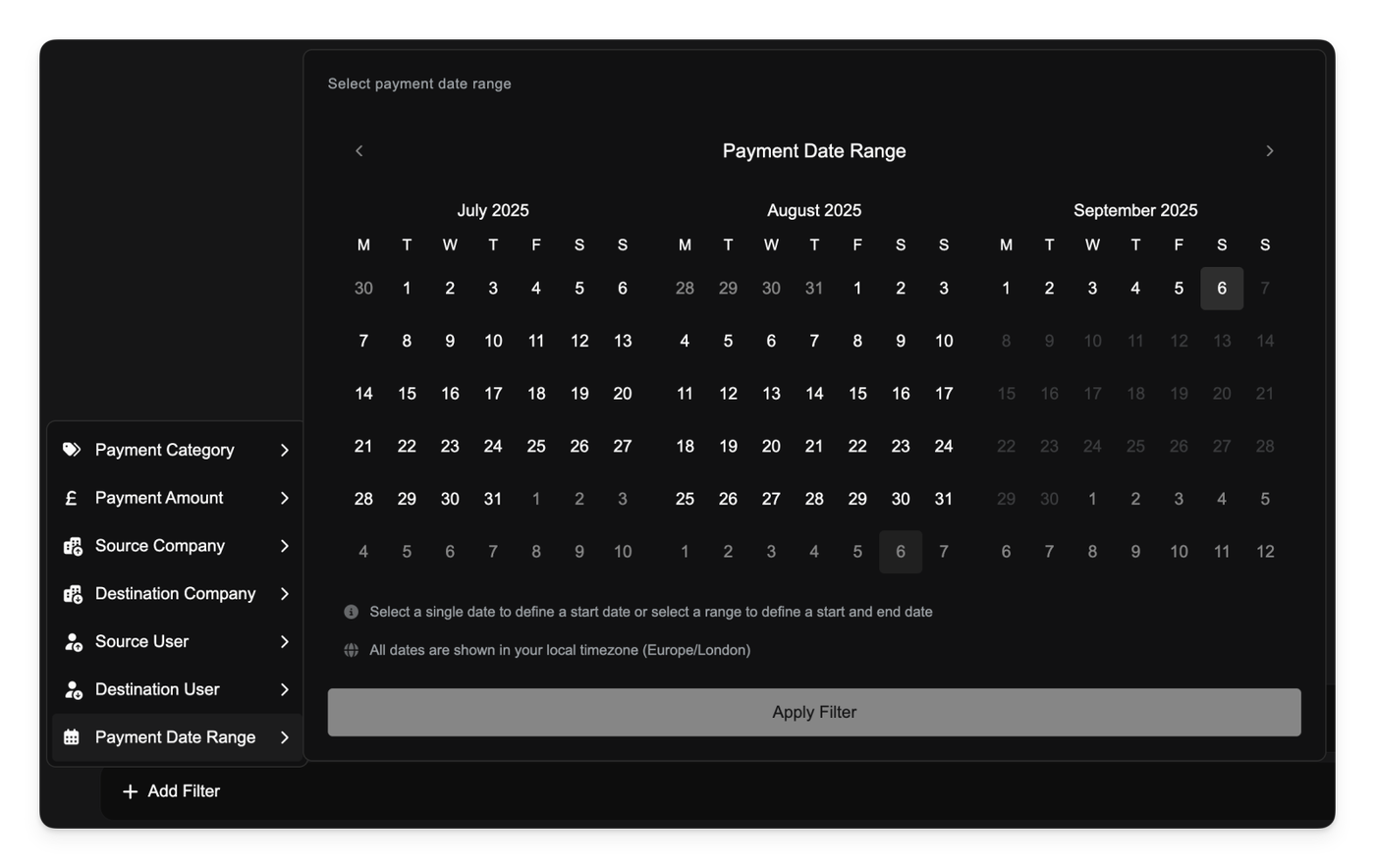
Finding flights from your allies and partners is now easier than ever. You can now filter the public flight board to show only jobs by companies belonging to specific partnerships.
When filtering jobs, you will see a new "Partnership" filter. Simply select one or more partnerships from the list, and the flight board will instantly update to display only flights from member companies. This makes it simple to support your partners, find specific charter flights from a major alliance, or just explore the operations of different groups.
Managing your own company just got simpler. You are now automatically assigned a special Owner Contract when you create a company, which means you no longer need to take up a regular pilot contract slot.
This new contract is designed specifically for you as the company owner. It features unlimited hours, so you never have to worry about renewing it. As a result of this change, you can no longer sign regular pilot contracts with your own company. Instead, your compensation is now handled through the new Owner Salary system.
Automated Owner Salary Payments
You can now automatically pay yourself a monthly salary based on your company's performance. A new Owner Salary section in your company settings lets you set a percentage of the previous month's net profit to be paid directly to your personal bank account.
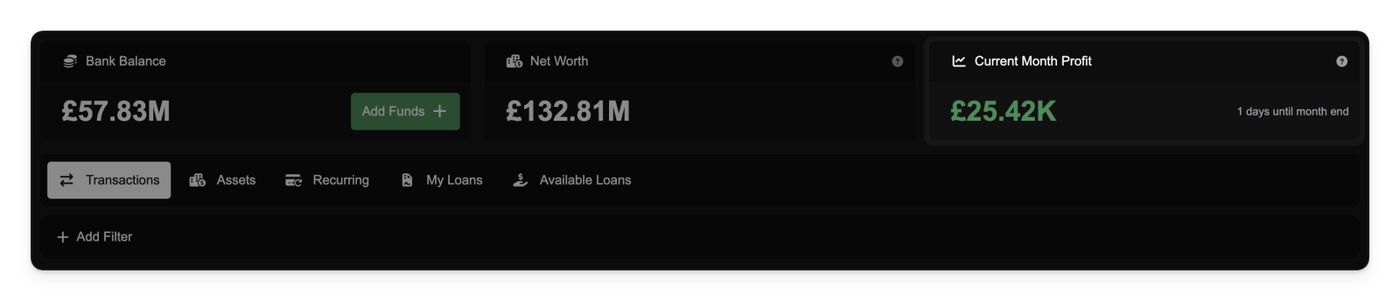
This system connects directly to the "Current Month Profit" figure on your finance dashboard. On the first day of each month, FSCharter will automatically calculate your company's profit from the previous month and transfer the designated salary percentage. The payment will appear in your transaction history as a "Salary" payment from your company.
This feature automates your compensation, rewarding you for running a profitable airline without any manual transfers. Simply set your desired percentage, and FSCharter handles the rest. If your company doesn't make a profit in a given month, no salary will be paid.
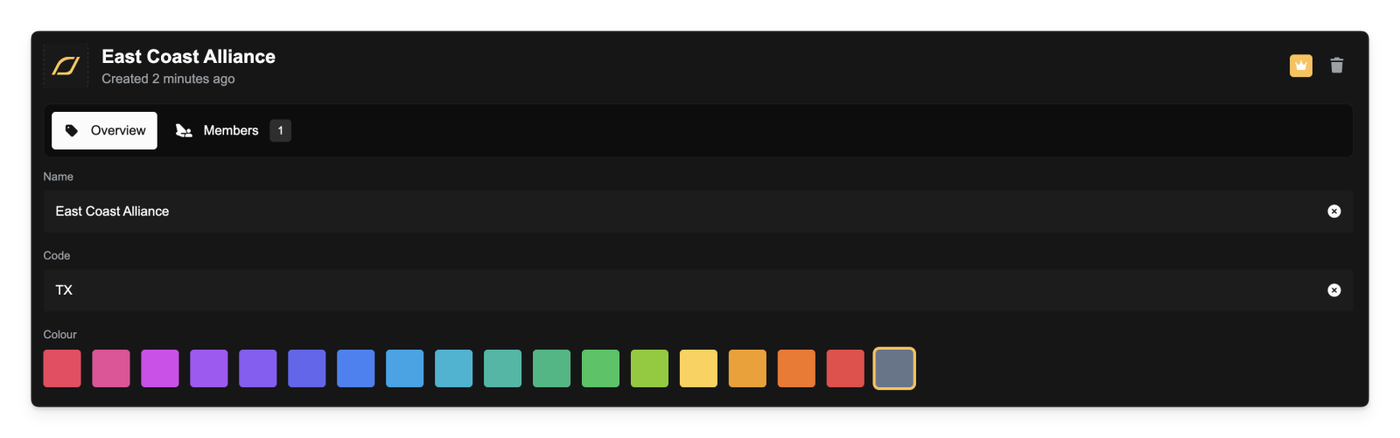
You can now customize your partnerships with a unique identity, including a logo, a 2-3 character code, and a brand color. This new branding will be displayed on the public flight board for every flight operated by a member company, giving your alliance more visibility.
When managing your partnership, you’ll find new branding options. You can upload a logo, set a unique alphanumeric code to represent your alliance, and choose a distinct color to make your flights stand out. If you don't choose a code, one will be automatically generated for you.
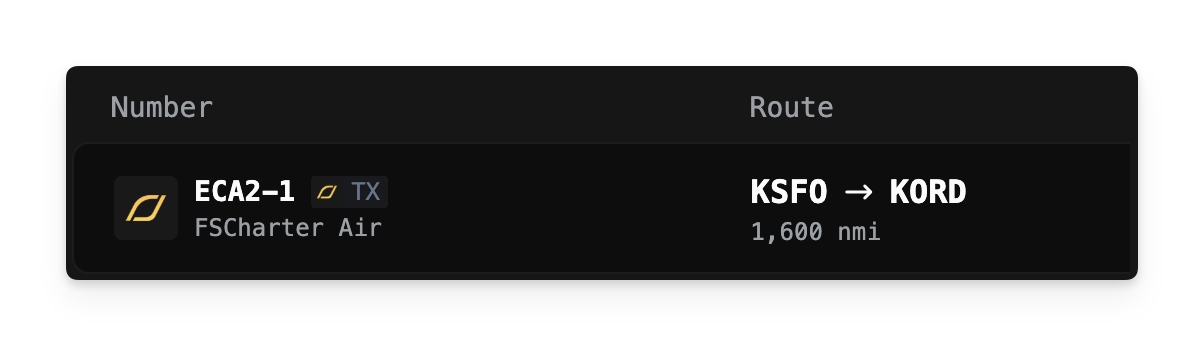
Once set, your partnership's branding will automatically appear next to every flight operated by any member of your alliance on the airport flight boards. This serves as a great way to advertise your partnership to other players looking for jobs, helping you attract new members and establish a recognizable presence in the world.
You can now clearly see which aircraft are occupying temporary slots directly from the Operations Cockpit, thanks to new slot status badges.
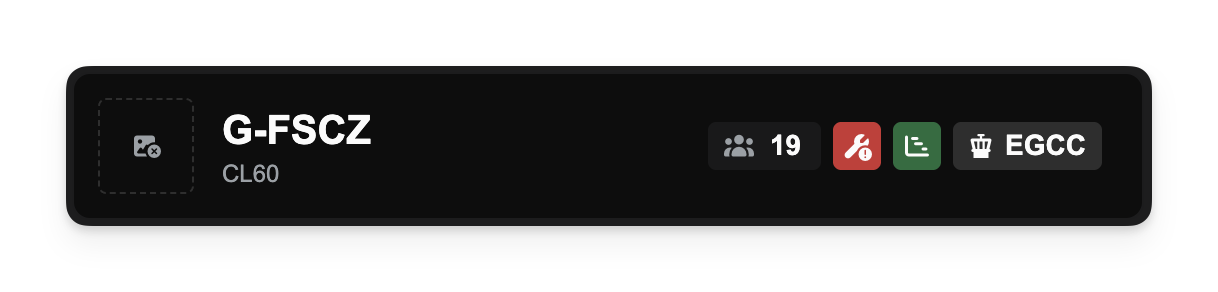
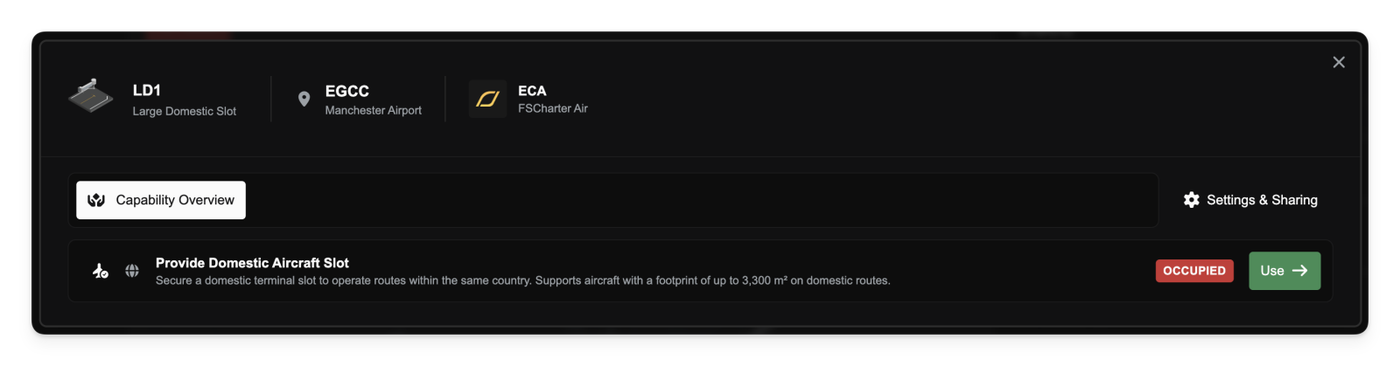
A new badge with a Gantt Chart icon now appears next to aircraft that are temporarily stored in a slot. These badges work just like those for stands and hangars - click them to view the associated agreement and owner information.
This visual cue gives you quicker insight into how your aircraft are positioned and helps you avoid surprises when managing limited capacity.
Other improvements
All aircraft movement buttons (Hangar, Slot, Stand) now show loading indicators during processing, making it clearer when actions are in progress.
Slot-related icons have been updated for visual clarity, distinguishing them from stand icons.
Fixed layout inconsistencies in slot configuration dialogs to ensure consistent company ownership display formatting across building types.
We’ve removed the Operations Centre (OC) requirements from all slot and stand agreements. Agreements no longer require any specific OC size or type to be purchased. This opens up access for airlines with alternative operating structures or smaller footprints.
In addition, the minimum term for all agreements has been reduced to 1 month, down from previous requirements ranging from 2 to 10 months. This allows for more nimble infrastructure decisions and easier trial of new locations.
Hourly Contract Rates & Sorting
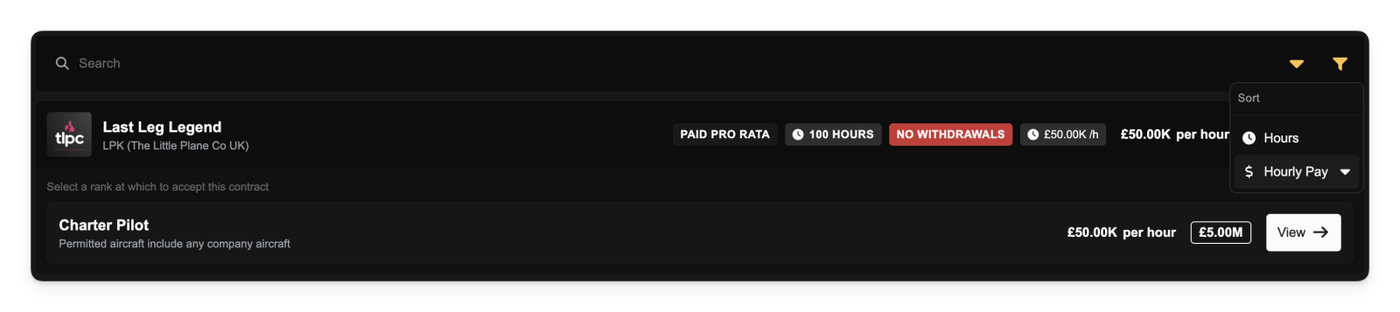
You can now see and sort contracts and contract types by their hourly rate, offering a much clearer view of pay relative to time commitment. The hourly rate is now shown across:
Active contracts
Marketplace listings (both summary and rank-level views)
Contract sorting options
This makes it significantly easier to compare job value, especially when contract durations vary.
Hourly rate sorting is now available in both the contracts tab and the contract type marketplace, helping users prioritize higher-value opportunities efficiently.
Fixes:
Improved tooltip logic and suffix formatting in price displays for better clarity.
Agreement requirements eased for Operations Centres
We've adjusted the Operations Centre (OC) requirements for international slot agreements to make them more flexible and accessible.
Previously, some agreements required you to have an OC at the specific airport where the agreement was signed. Now, these agreements only require you to have a suitably-sized OC anywhere within the same country. This means a single Operations Centre in the United Kingdom, for example, can now support international slot agreements at both London Heathrow and Manchester without needing a separate building at each.
In addition, the minimum OC size required for some international slot agreements has been reduced. For example, some agreements that previously required a 'Large' OC now only require a 'Medium' one. These changes should make it easier and more cost-effective to expand your international route network.
Live Map gets ATC-style labels
The live flight map has been updated to include Air Traffic Control-style data blocks for each aircraft. This provides more information at a glance, showing the aircraft's callsign and tail number directly on the map for easier identification and tracking.
Passenger Weight Adjustment
The standard weight for passengers has been updated to 100kg. This change accounts for the average weight of a passenger plus their baggage, providing a more realistic figure for weight and balance calculations in your flight planning.
Other Improvements & Fixes
Operations Centre Sales: You will now be prevented from selling an Operations Centre if you have active agreements at that airport or in that country that depend on it. This ensures you do not inadvertently violate the terms of your agreements.
Automatic Aircraft Movement: When a pilot accepts a route-based job, their aircraft will now be automatically moved from its hangar or stand into the correct departure slot.
Agreement & Building Naming: When purchasing new buildings or signing new agreements, the default naming system will now correctly increment names (e.g., "My Hangar 2") only when another asset with the same name exists at the same airport, allowing for clearer organisation across your network.
Route Re-evaluation: The process for re-evaluating route enablement after a change in your slot agreements has been moved to a background job. This will improve performance and reduce loading times when making changes that affect a large number of routes.
Airport Search: An issue that could cause errors when searching for airports under specific map conditions has been resolved.
Demand Filtering: A bug affecting the "total demand" count filter has been fixed, leading to more accurate results when searching for demand.
SimBrief Settings: The company settings page for SimBrief integration is now only visible to users with the appropriate permissions.
Company Deletion: The process for deleting a company has been improved to correctly clean up all associated data, including airport reachability and capability usage records.
We've changed how routes are enabled and managed. From now on, all routes will require an available Slot to operate. Slots are a new type of recurring agreement within the game, designed to provide a more realistic and structured approach to network management. They come in two distinct types: domestic for internal flights and international for flights crossing borders. This change means you'll need to secure the correct type of slot for each route you wish to fly.
Manual route control
In addition to the new slot system, we're giving you more direct control over your flight network. You can now manually enable or disable routes as you see fit. This allows for greater flexibility in managing your network. Disabled routes do not contribute to your route network at all, effectively behaving as if they were deleted.
Stands for airliner parking
A new type of parking agreement, Stands, is now available. These are specifically designed for airliners. Unlike General Aviation (GA) aircraft, airliners do not accrue accelerated maintenance when parked outside, making stands a more flexible parking solution for your larger aircraft. While primarily for airliners, you can also use any spare stand capacity to store your GA aircraft, protecting them from parking fees when you find yourself in a pinch.
Auto-storage for aircraft
We've introduced a new auto-storage system that intelligently manages where your aircraft are parked. The system uses a priority-based approach to automatically assign aircraft to the most suitable available space. It will prioritise hangars for aircraft that benefit most from being sheltered and then allocate remaining aircraft to stands or other available parking. This should reduce the amount of manual shuffling required to keep your fleet organised and maintained.
Company clock visualisation
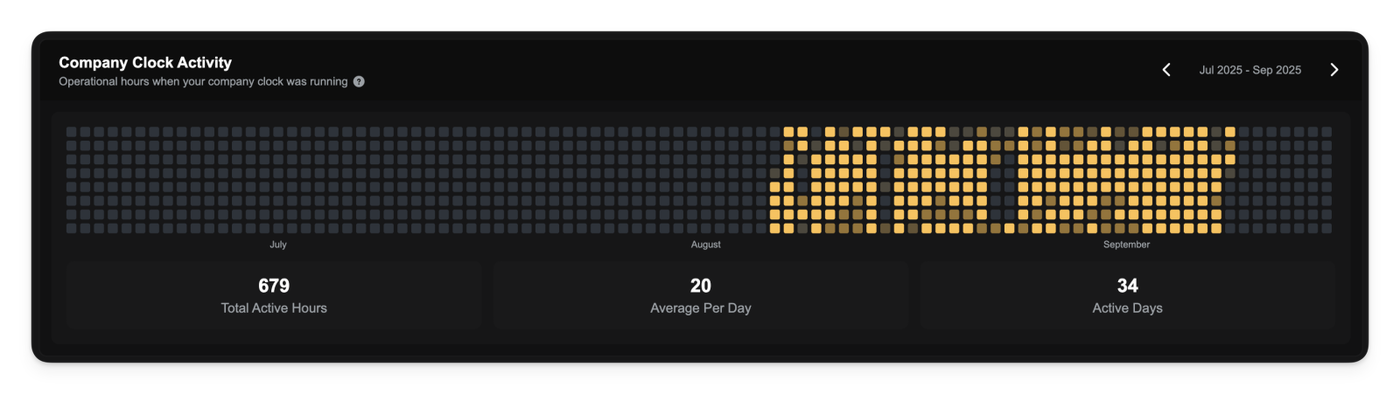
To help you better understand the activity of your business, we've added a new company clock visualisation. This feature provides a heatmap of your company's operational hours, showing you at a glance when your fleet is most active and when it's idle. You can use this information to identify patterns and make more informed decisions about your company's operations.
Other Fixes & Improvements
A bug that sometimes prevented aircraft from loading on the flight map has been resolved.
The user interface for capabilities has been updated with a stacked progress bar, offering a clearer view of your usage and reservations.
You will now receive notifications for any issues related to aircraft parking and a lack of available storage space.
General Aviation aircraft will now be subject to idle wear and tear when stored outside of a hangar.
For easier management, all recurring payments have been consolidated and are now processed through the company clock.
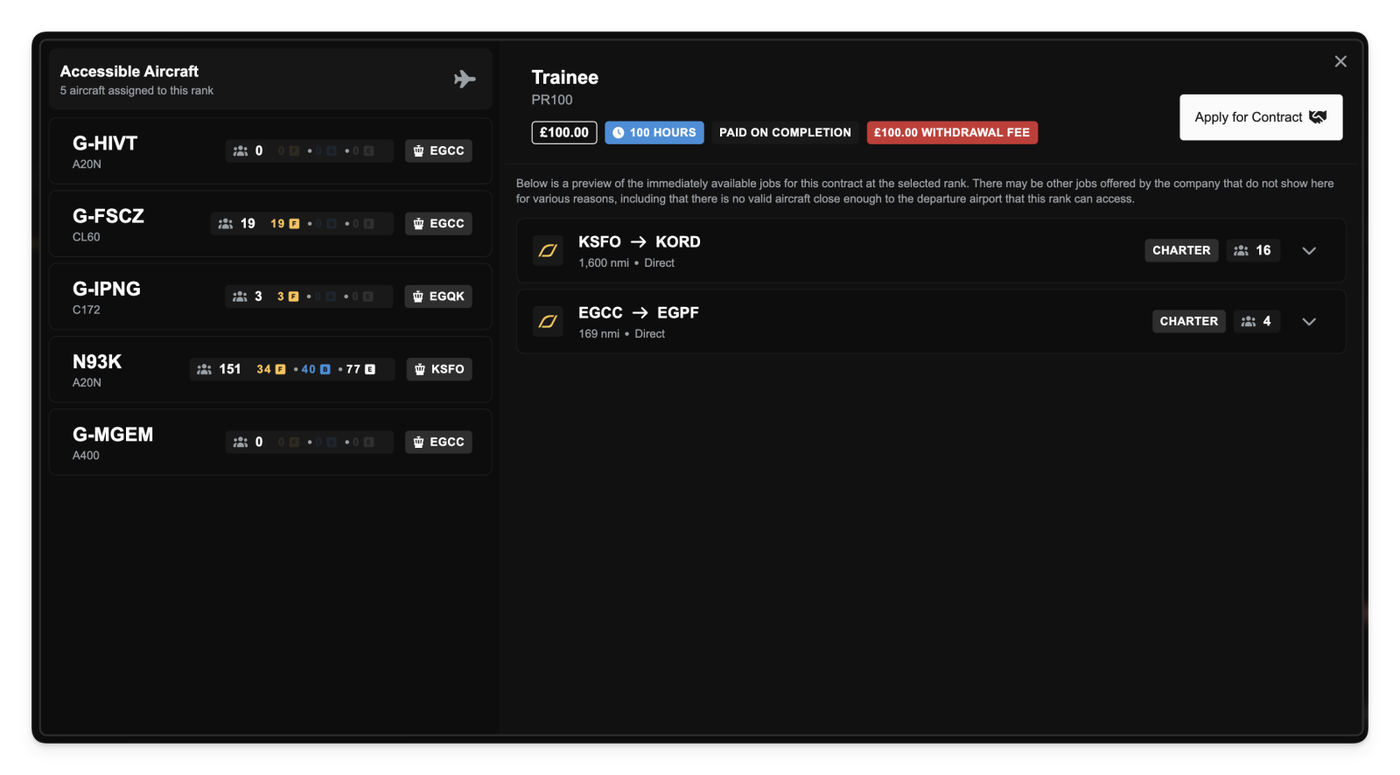
Pilots can now withdraw their own pending contract applications. If the company has enabled withdrawals, an optional cancellation fee is shown up front. Free withdrawals are supported when the fee is set to £0. Companies can also disable withdrawals entirely.
Applications now display a live “Expires in …” badge while they’re pending. If a company doesn’t act in time, the application is automatically rejected after the timeout window (default 7 days). No withdrawal fee is charged for these automatic expiries, and you’ll receive an in-app mail letting you know.
For extra transparency, the Marketplace and company contract type lists now clearly show whether withdrawals are allowed and, if so, the fee you’d pay for backing out before approval.
Personalize Your Fleet with Custom Aircraft Images
You can now upload custom images for each aircraft in your fleet. From the Aircraft Dialog, you'll find a new option to upload an image, which will then appear across the platform in the Operations Cockpit, on maps, and in tooltips. To help manage this, a new Change Aircraft Settings privilege has been added to company roles. As a bonus, when you list an aircraft on the classifieds, its custom image will automatically be used for the sale listing.
Learn the Ropes with On-Screen Tours
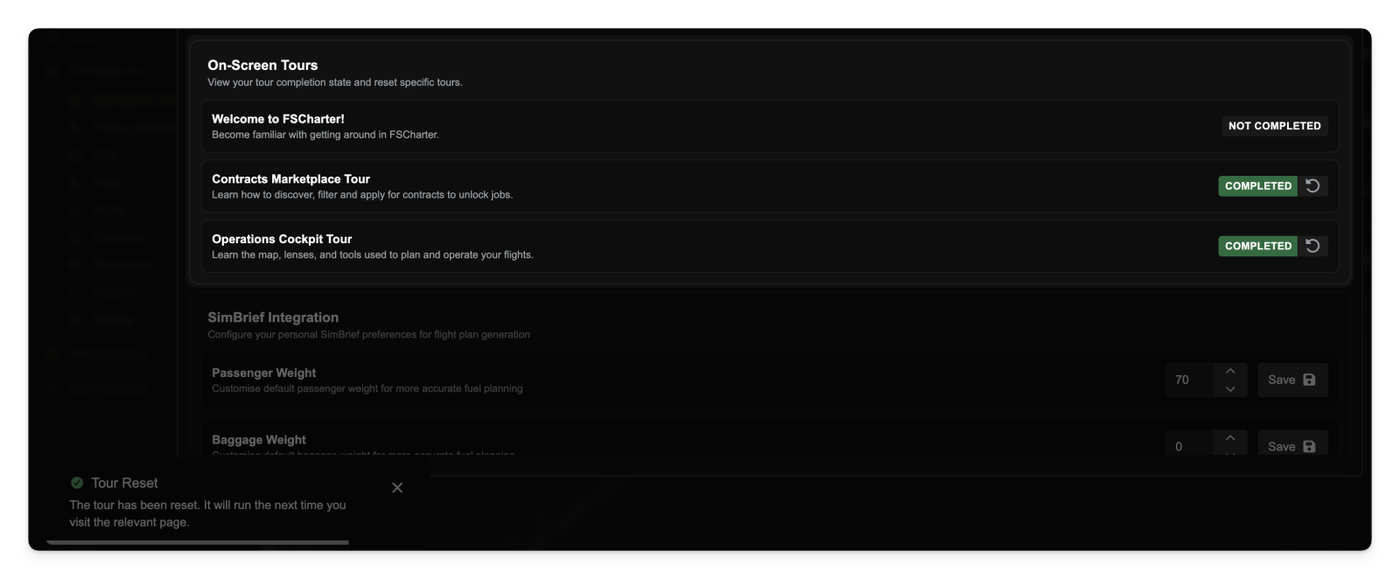
To help new players get started we are introducing interactive on-screen tours. These step-by-step guides will walk you through key interfaces and features directly within the application. Tours can be reset at any time from your settings page.
Other Changes
Improved:
Optimized the loading performance of the Job Constraints and Available Aircraft tabs in the Operations Cockpit, making the interface feel faster and more responsive.
When an aircraft with outstanding finance is migrated from V1, the system now refunds the amount invested to the company bank account and the aircraft is not transferred.
There is now an option to re-send the password reset email when migrating from V1.
Fixed:
You can no longer start aircraft servicing (either manually or automatically) if the aircraft is assigned to an active job.
It is no longer possible to create a ferry job for an aircraft that is currently undergoing maintenance.
The progress bar on the Active Flight widget now correctly displays the flight's progress.
The Available status filter option on the Flight Board has now been removed.
Fixed an issue where it was possible to attempt to terminate a contract that had already been completed.
Route numbers now support an optional letter suffix
Route numbers can now include a trailing letter, letting you publish variants like 101A/101B for split operations or time-of-day pairs.
Fixes
Fixed a bug where route numbers could not be renamed.
Fixed an availability check edge case where numbers with letter suffixes could be misdetected on the client side, ensuring accurate “already in use” validation before save.
Premium Core users and companies now have access to a suite of customisation options to fine-tune their Simbrief outputs from FSCharter.
Custom Airframe Mapping & Weights
Customise passenger and baggage weights for Simbrief and map your FSCharter aircraft to SimBrief airframes using either the tail number or aircraft type. Mappings and weights are automatically applied when generating a Simbrief dispatch.
Company Airline Code
Companies can now configure a custom airline code that overrides the default ICAO when generating SimBrief flight plans. This makes flight numbers and callsigns match your organization's branding.
Active Job Widget
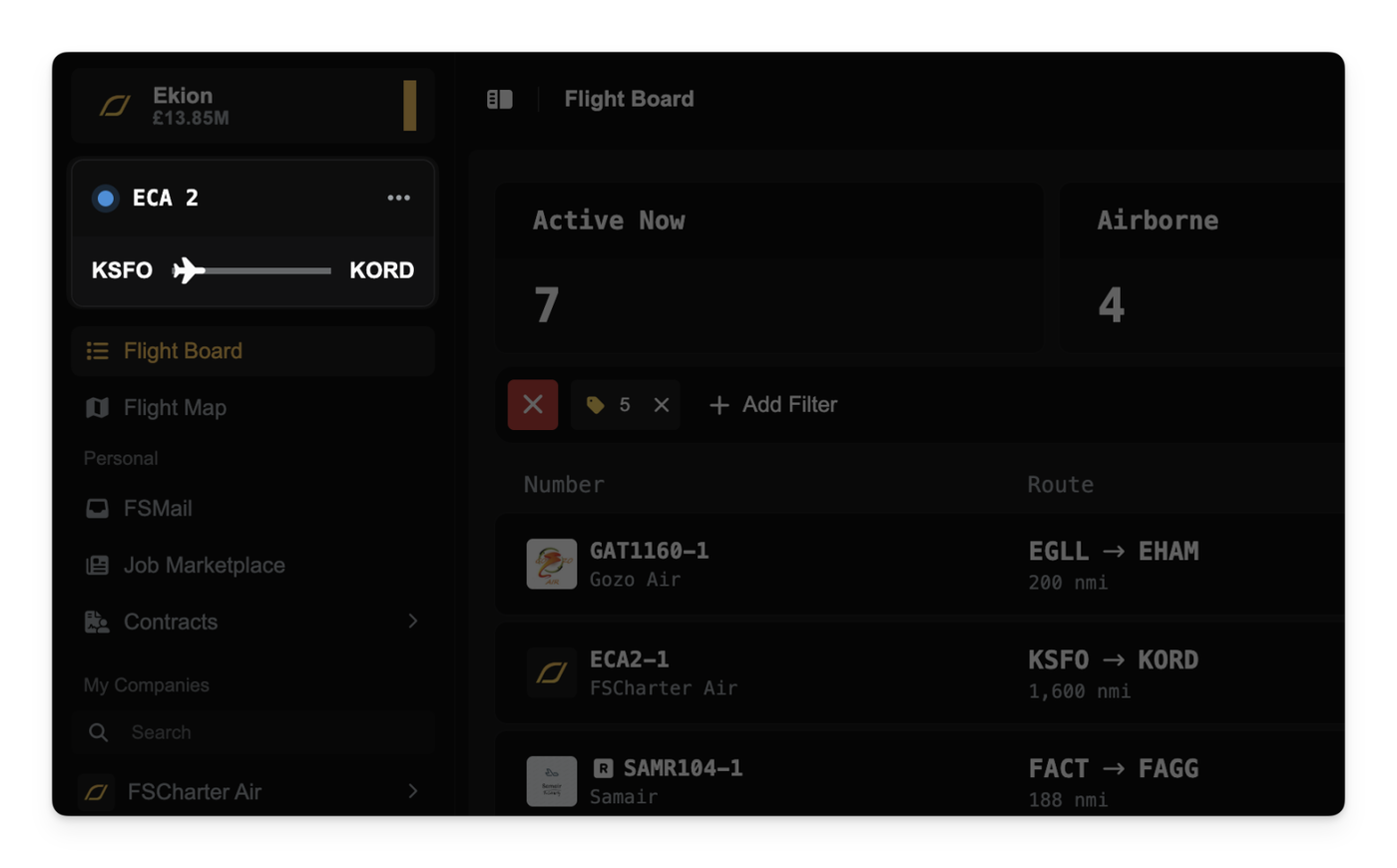
Quickly access your current flight with the Active Job widget in the sidebar. It shows your job progress, aircraft, and route at a glance, and gives one-click access to SimBrief, job details, or leg tracking - all without navigating away from your current screen.
Improvements
SimBrief links now open with improved URLs that incorporate custom preferences and company branding when available
Fixes
Removed the outdated "My Jobs" section from the sidebar navigation
Improved error handling when opening SimBrief without an active job leg