Owner pilots are handled correctly in the Aircraft for Hire marketplace(#1017) When browsing hireable aircraft demand, pilots with an owner rank in the company now see a cleaner, more accurate experience. The hourly rate display is replaced with "Paid via dividends" — since owner pilots aren't paid by the hour — and the option to change rank is hidden, as it doesn't apply. Previously, owner pilots were shown the same rank-switching flow as regular roster pilots, which prevented them from accepting the job.
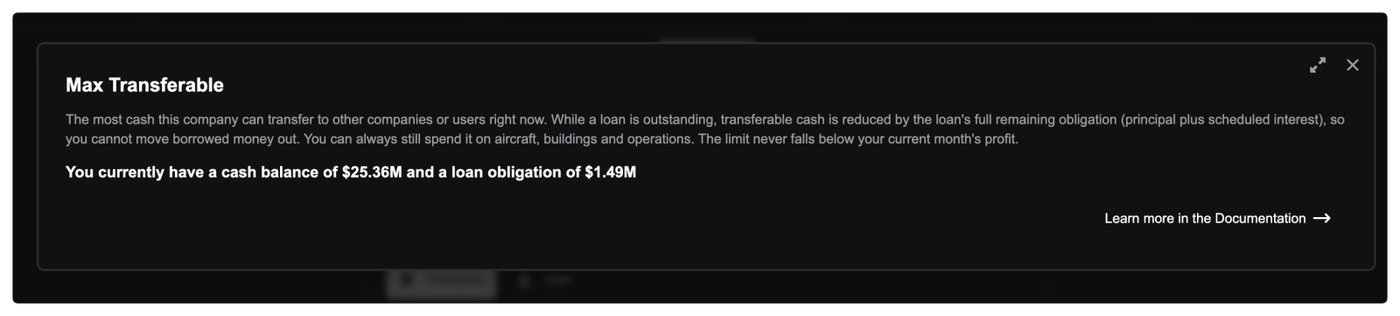
Net worth tooltip now explains how the figure is calculated(#1019) The help text on the Net Worth figure in the Finance tab has been updated to make clear that liabilities (loans) are subtracted from the combined total of your assets and bank balance. The figure itself hasn't changed — just the explanation.
Bug Fixes
Typing in currency fields no longer mangles the value(#1018) An issue where editing numbers in currency input fields could produce incorrect results (for example, deleting a digit from "300" and typing another could result in "20" instead of "200") has been fixed. The input field now preserves exactly what you type while you're actively editing.
Auto-Maintenance now performs the correct check level (FSC-3661)
When multiple maintenance checks were overdue at the same time, the system was incorrectly triggering a lower-level check (e.g. an A-Check) before performing the higher-level check that was actually due (e.g. a B-Check). Since a B-Check already covers everything an A-Check does, this caused unnecessary extra downtime and cost. The system now correctly identifies the most comprehensive check due and performs that directly.
Collaboration dashboard no longer shows passengers who aren't ready (FSC-3818)
The collaboration dashboard was including legs where passengers were still in transit between connections and not yet ready to board. It now only shows legs where passengers are actively waiting to depart, giving a more accurate picture of what needs servicing.
Create Charter Mode now applies the correct demand filter (FSC-3904)
Reported by community member milliotseb. Create Charter Mode was applying an "amount available" filter when the option to sync filters was selected instead of the "group size" filter. This caused fewer charter proposals to appear than expected, incorrectly excluding demand that could be served in smaller groups. It now correctly applies the group size filter instead.
Charter bonus exploit prevention (FSC-3885)
The charter bonus structure could be exploited by splitting a single journey into many short legs across separate jobs, multiplying the payout. Now, each company can only earn one charter bonus per passenger group, regardless of how many legs they operate. Normal charter revenue without the bonus is still earned on subsequent legs.
Stability fix for aircraft reporting (FSC-3905)
An out-of-memory database error could occur when certain sitreps were generated under load. This has been resolved.
In our Open Beta survey, 75% of you told us it was difficult or very difficult to turn a profit. The economy was the #1 frustration. Charter limitations, demand distribution, and the feeling that the deck was stacked against smaller operators came up again and again. This patch is our answer to those concerns.
Here's what matters most:
The charter aircraft cap is gone. Fly charters in anything, with a new bonus system that makes small charters way more profitable. The demand engine has been rebuilt from the ground up with fairer global distribution, more economy passengers at airports that matter, and higher economy fares to match. A new Create Charter Mode lets you pick an aircraft and find work for it instead of the other way around. And every new and existing aircraft gets one free cabin reconfiguration to adapt to the new demand landscape. Full details below.
What's Changed
1. Charter is Unshackled
The 20-seat charter cap is gone. Completely removed. You can now charter any aircraft in your fleet, from a Cessna 172 to a 777. No permits, no artificial restrictions.
The economy now naturally balances itself. Charter now uses an exclusivity bonus that rewards small, intimate charters and progressively penalises you for trying to run a 200-seat airliner as a taxi service. Passengers expect exclusivity when they book a charter. Cram 100 people in and your revenue per head drops by ~75%. Keep it under 40 passengers and you get the full bonus with no penalty at all.
Charter bonus per person: Up to £967 per person for a solo charter, scaling down as you add passengers. A 10-passenger charter still earns £716 per person on top of the base fare. The bonus tails off around 30-40 passengers, and above 40 a capacity penalty kicks in.
Passengers
Bonus/Person
Capacity Penalty
1
£967
None
10
£716
None
20
£513
None
30
£367
None
40
£270
None
50
£188
~28% total revenue cut
80
£71
~65% total revenue cut
The takeaway: small charters are now genuinely lucrative. A well-planned 4-passenger business jet charter can earn good money. We hope that this is a giant leap in the right direction for the economy that the survey called for. Smaller operators have a real competitive edge in the charter market now.
But it's not just small aircraft that benefit. Combined with the demand changes below (more economy passengers, higher economy fares), chartering economy passengers in larger aircraft is now a genuinely viable strategy. There's a ton of demand out there and the charter bonus still applies up to 40 passengers with no penalty. The cap removal plus the new bonus structure means you have options that simply didn't exist before. For the full breakdown of how charter bonuses and the exclusivity multiplier work, check out the Charter Jobs documentation.
2. Demand Has Been Rebuilt From the Ground Up
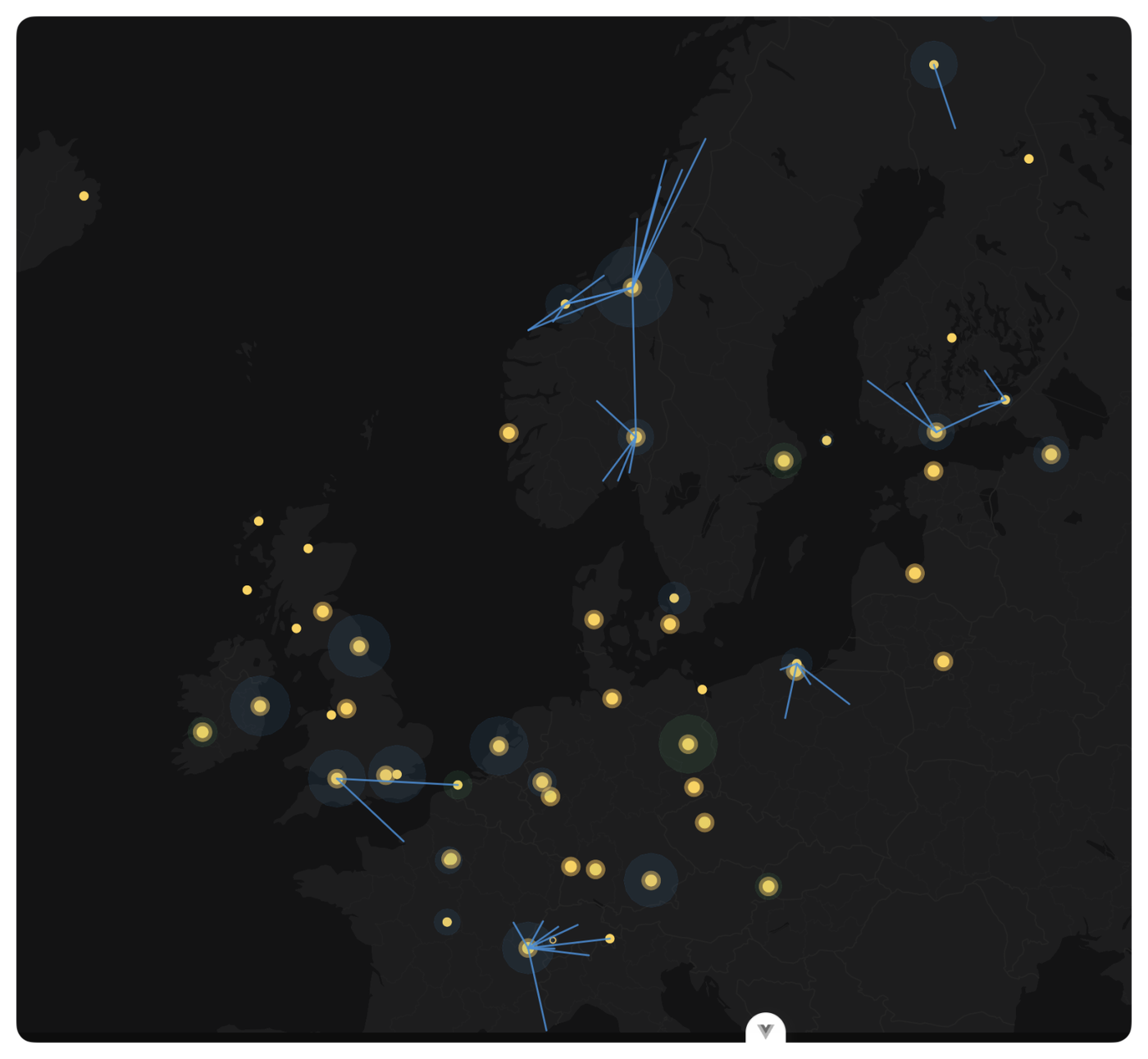
We've overhauled how the demand engine generates and distributes passengers across the world. The old system had a massive skew toward the USA and Brazil (where ~60% of all airports are), with places like Spain and China getting disproportionately little traffic. The new system accounts for:
Airport density: Areas with hundreds of tiny airfields in a small radius (New York, Sao Paulo) no longer hog a disproportionate share of global demand
Country airport count: Countries with fewer airports are no longer punished for it
Class-specific geo-scoring: Every airport now has separate economy, business, and first class scores that influence where passengers spawn and where they want to go
What this means in practice:
Economy passengers cluster around larger airports. No more random economy demand spawning at a grass strip in the middle of nowhere. If you're running economy routes, focus on the airports people actually fly through.
First and business class are more spread out. Premium passengers travel to more varied destinations, rewarding diverse route networks.
Economy passengers pay more. With the demand ratio shifting toward economy, we've increased economy fares proportionally so that economy routes remain profitable. Any existing collaborative demand has also had prices scaled up.
Demand fills fast. The demand engine can now generate the full 8 million passenger groups in approximately 3 hours instead of taking over a week. After this patch, demand has been fully reset and will populate quickly.
Behind the Scenes: The Demand-o-Matic
Distributing demand fairly across 36,000+ airports is a serious big data problem, and getting it right required purpose-built tooling. RCTO has developed an internal tool (that we affectionately refer to as the Demand-o-Matic) that powers the new geo-scoring system behind this update.
The tool combines UN travel data, World Bank GDP figures, and a database of over 40,000 real-world entities (think Disneyland Paris, the Bank of England, the Statue of Liberty) to build a model of where passengers actually want to go and why. Each entity contributes a weighted pull on nearby airports, giving demand a grounding in real-world travel motivation rather than random distribution.
Passenger class scoring is split by travel purpose. Economy passengers are weighted more heavily toward tourism entities, while business class passengers lean toward commercial and financial centres. First class demand is deliberately spread thinner and into less obvious locations, making premium passengers harder to gather but more rewarding when you do.
One of the biggest problems the tool solves is clustering. In the old system, every airport effectively acted as a lottery ticket for demand. The more airports a country or region had, the more demand it won. The USA holds roughly 60% of all airports in the game, so areas like New York and Sao Paulo were hoovering up a disproportionate share of global traffic. Meanwhile, countries like Spain, which has relatively few airports for its size, were being unfairly underserved. The Demand-o-Matic runs geospatial calculations to counteract this, so demand distribution is based on where people actually travel rather than where airports happen to be densely packed.
This tool is what makes it possible to keep iterating on demand balance going forward. The scores in this patch are the result of months of testing and adjustment, but the tooling is now in place to make further refinements as we gather feedback.
3. Create Charter Mode (Premium Core)
A massive quality-of-life upgrade for charter companies. Create Charter Mode flips the Dispatch Plan workflow on its head. Instead of browsing demand and hoping something fits your aircraft, you pick your aircraft first and the system shows you what it can fly.
The old way: Browse the demand map, find interesting passengers, then figure out which aircraft can fly them.
The new way: Pick your aircraft first. The system shows you every demand group it can reach, filtered to its range and capacity.
Key features:
Interactive seat map: Watch passengers fill your cabin in real time as you select demand groups. Click any filled seat to remove that group.
Filter Sync: Toggle this on and the demand list automatically updates as you fill seats. Select 12 of 19 seats? The list now only shows groups of 7 or fewer. No more accidentally overfilling.
Map integration: Ctrl/Cmd-click demand lines on the map to add or remove groups directly.
Release & Accept: One-click shortcut that publishes the job and immediately assigns it to you as the pilot. No need to visit the marketplace.
Switch aircraft mid-flow: Realise a different aircraft would be better? Swap it out without losing your selected passengers.
Ferry companion: Each aircraft row has a split button with both Charter and Ferry actions. Reposition to a better airport first, then charter from there.
Create Charter Mode is available from the Operations Cockpit > Aircraft lens. It complements the existing demand-first workflow. Use whichever fits what you're doing.
Every aircraft now gets one free cabin reconfiguration, applied instantly with no downtime. This new feature can be accessed from the Aircraft Layout tab of your Aircraft dialog in the Operations Cockpit.
With the demand model shifting toward more economy passengers, your current cabin layouts may not be optimal. This free reconfiguration lets you adapt without penalty. Use it to match the new demand reality. You'll likely want more economy seats on most aircraft going forward.
Financial Previews
You can now see estimated and actual financials for all jobs and routes, including fuel costs, landing fees, ATC charges, customs fees, and revenue. Available both during charter creation and after the fact.
During charter creation: See revenue estimates and cost breakdowns as you build your dispatch plan, so you know whether a charter is profitable before you commit.
After completion: Review what you actually earned vs. what it cost. Fuel burn is calculated from your real flight history average for that aircraft type.
Ferry jobs too: Fuel and landing fee estimates for repositioning flights, so you can factor ferry costs into your charter planning.
Route financials: View estimated revenue based on demand minimums, with a passenger count parameter to model different load factors.
No more flying blind on whether a job is worth taking.
Other Improvements
Release & Accept for jobs: Jobs and dispatch plans can now be released and accepted in a single action. No more releasing to the marketplace and then racing to accept your own job.
Restyled Aircraft rows: The Aircraft lens in the Operations Cockpit has been redesigned with split action buttons, letting you launch Create Charter Mode or create ferry flights directly from the dock without extra navigation.
Aircraft location flags: Aircraft rows now display the flag of the country where the aircraft is currently located, making it easy to scan your fleet's global positioning at a glance.
Demand date filter: Filter demand by the date it was generated, useful for spotting fresh demand.
Demand badge on jobs: The Job dialog now shows a badge with seat requirements by cabin class (Economy/Business/First), so you can see at a glance what a job needs.
Massively faster route demand loading: Route demand queries have been optimised from ~8 seconds down to ~266ms (a 30x speedup). The demand map and route demand refresh should feel dramatically snappier, especially on servers with full 8M-row demand tables.
Map reliability fixes: Fixed race conditions in the deck.gl map layers that could cause route lines to not update properly when dragging or switching views.
Bug Fixes
Fixed unfair last-leg payment distribution. A significant bug where the final leg of a multi-leg journey was receiving a disproportionately large share of the total payment. All legs now receive their fair proportional share based on distance contribution. Also corrected the calculation that determines how passenger budgets are split across legs, ensuring accurate pricing throughout multi-leg journeys.
Fixed charter job configuration bugs. Resolved multiple issues in dispatch plan and job configuration that could cause incorrect leg assignments, seat allocation errors, and routing problems.
Fixed orphaned jobs after demand removal. Removing demand from a dispatch plan now correctly cleans up orphaned job legs and recalculates seat requirements, preventing ghost jobs from lingering.
A Note on Testing
These changes have been through extensive internal testing over the past few weeks. We've been hammering the new demand engine and the charter economics on staging for a while now. That said, this is a big patch touching a lot of interconnected systems. If anything doesn't look right, feels off, or the numbers seem wrong, please reach out. We'd much rather hear about it than have you quietly frustrated. Your feedback is what got us here, and it's what'll keep us improving.
What's Next
Next up: cargo. It was the #1 most-requested feature in the survey and it's on the roadmap. More to come on that soon.
Charter hire demand no longer shows a misleading per-row payout of £0.00. Instead, you get an estimated pay shown at the top based on your rank and the expected flight time for the route. The estimate is calculated from the route distance (multipled by 1.2) and the aircraft’s cruise speed.
A new help tooltip explains the calculation and the realism factor used to account for climb, descent, and non-perfect routing.
Other improvements
Relocation for hireable aircraft is now based on your rank’s aircraft constraint radius (one consistent rule), instead of separate aircraft-level relocation settings.
Fixed an issue where switching between aircraft could leave old demand filters behind, causing incorrect or missing demand results.
You can now filter job routes on the Job Marketplace map so only jobs fully visible in your current map view are shown. When the default behaviour is toggled off, a job disappears as soon as either its origin or destination moves outside the map viewport.
Updated seats on Pilatus PC-12 from 10 to 9 and increased MTOW from 4,500kg to 4,740kg
Updated seats on Airbus A321 neo from 230 to 244 and renamed to A321neo LR
Updated OEW for Airbus A321XLR from 49,000kg to 46,600kg
Persistent Rank Approval
You no longer need to re-apply every time you return to a rank you’ve already been cleared for.
When a company approves you for a rank (whether manually by a manager or automatically through progression or eligibility) that approval is now remembered. If you later switch away and decide to come back, you can move straight into the rank without waiting for approval again.
In the Pilot Portal, ranks you’ve previously been approved for are clearly marked as Pre-Approved. These ranks let you switch instantly, even if they would normally require an application.
Other Improvements
NOTAM messages now show a live character counter, so you always know how close you are to the 255-character limit
Fixed arrow key navigation being intercepted while typing in company description and message fields
Managing the release of collaborative demand across multiple airports is now significantly faster and more controlled.
You can select multiple airports directly in the Collaboration Dashboard and release demand for all of them in one action. A new batch selection bar appears as soon as you start selecting rows, clearly showing how many airports are selected and which actions are available.
Two batch actions are available when you have the appropriate company privileges:
Release All: Releases all collaborative demand for the selected airports.
Release Urgent: Releases only demand that has exceeded the urgent threshold, leaving newer demand untouched.
Company Logos and User Avatars in Selectors
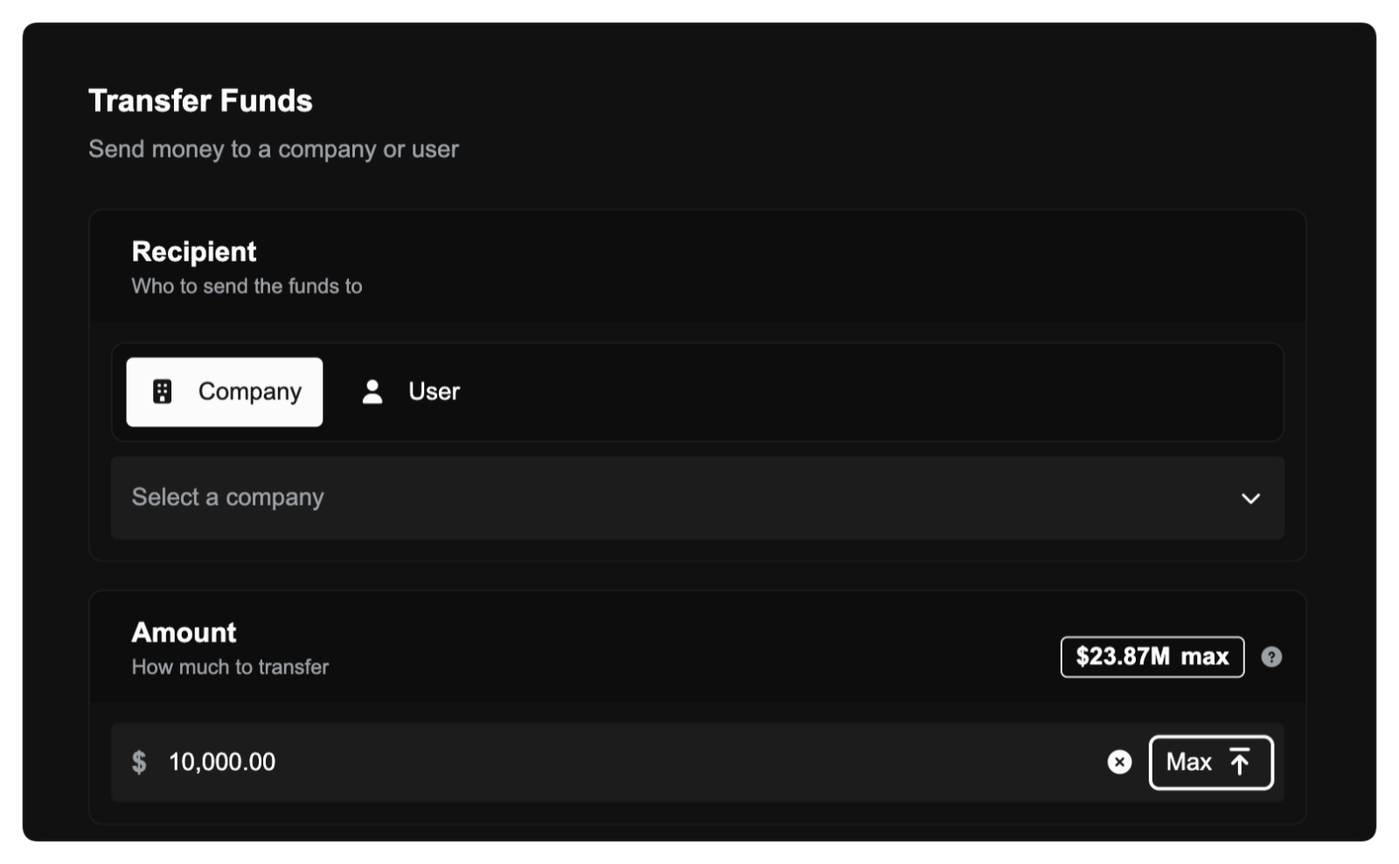
Company and user selection fields are now more visual and easier to scan. Wherever you choose a company or user (such as transferring funds, deleting a company, or selecting a recipient) logos and avatars are displayed alongside names instead of generic icons.
This makes it quicker to identify the right company or person at a glance, especially when working with long lists or similar names.
Aircraft Market Listing Enhancements
Used aircraft listings are now clearer and more informative. Broker sales and third-party sellers are highlighted directly on the aircraft image with new badges, making it obvious who is selling the aircraft.
Smarter Hangar Storage for Company-Owned Buildings
A bug with aircraft storage logic has been fixed to better reflect ownership. Previously, if you owned a hangar but had set it to public use for a fee, your own aircraft would not automatically use it after slot grace periods end.
Now, if you own a hangar, your aircraft will always automatically use it for storage, even if that hangar is set to public access with a price. You never pay storage fees to yourself, and aircraft will no longer be pushed into less suitable public storage because of pricing settings.
Other improvements
Fixed tables scrolling slightly within tables
Minor visual polish across aircraft listings and dashboards
The FSMail message that is sent to all partners when demand is released back to the public pool now shows a breakdown by departure airport and class, so you can immediately see where demand is coming from.
Fixed the FSMail message viewer to properly scroll for long messages
The Airport Lens Space for (m²) filter now accepts larger values instead of being capped at 999
SimBrief exports now correctly exports payload values
Fixed the Route Lens Does Not Meet Minimums filter from showing routes from all companies
You can now see what’s happening across all companies in FSCharter in one live, real-time feed.
The new Activity Feed page brings together major events from every company into a single global timeline. As flights depart and land, jobs are accepted, aircraft are traded, or companies join partnerships, you see it instantly.
Each entry is clearly labelled with readable titles, meaningful descriptions, and visual icons so you can quickly scan what’s going on. You can also filter the timeline by company or activity type, making it easy to focus on competitors, partners, or specific kinds of events.
The feed updates live while you’re on the page and supports infinite scrolling, so you never miss what’s happening across the world.
Clearer Pay Progression and Pending Earnings
You now get much better visibility into how and when you get paid as a pilot.
In the Career Progression tab in the Pilot Portal for a company, each rank now shows:
How many hours you’ve flown at that rank
How many hours remain until your next payout
How much money is currently pending
How often that rank pays out (pay interval)
This makes it much easier to understand why pay is pending and exactly what you need to do to unlock it. If a rank pays every 10 hours, you’ll now clearly see your progress toward that threshold and the amount building up along the way.
The My Work page has been upgraded to give you clearer, more actionable information. At the top, Pending Payouts now includes contextual help explaining:
Why pay can be locked to specific ranks
How switching ranks affects pending earnings
How to unlock accumulated pay
Each company row now shows:
Progress toward your next payout at your current rank
Pending amount for that rank
Lifetime earned and pending amounts
Total hours flown
You can now also jump straight to managing your pilot career from My Work. A new Manage Employment button takes you directly to the Career Progression tab for that company, where you can:
Switch ranks
Review pay intervals
See which ranks have pending pay waiting to be unlocked
This removes the need to hunt through company pages to manage your pilot status.
New Job Filter: Hourly Pay
You can now filter jobs by hourly pay, letting you focus on work that matches your earning goals. The filter intelligently accounts for:
Your current rank if you’re already employed
Ranks you’re eligible to apply for
Auto-accept ranks when “Flyable Now” is enabled
This helps surface jobs that actually make sense for you to fly.
Other Improvements
Fixed airport type data so heliports are correctly classified
Improved activity log titles and descriptions throughout the platform for clearer, more readable events
Visual polish and spacing improvements in timelines and panels
This release represents one of the largest structural updates to FSCharter since launch.
The focus has been on reducing friction and making long-term progression feel more intentional for both pilots and company managers. Core systems such as contracts, job discovery, company interaction, and rank progression have been reworked to and make the platform easier to understand and operate for both beginners and long term users.
For pilots, the aim of this update has been to make jobs much easier to find and to reduce the overhead of using FSCharter. For managers, the update brings better tools, less micro-managing, and more control over how companies are structured and run.
We've updated the the documentation to reflect this change and we'll be updating the videos soon. Here are the most notable documentation pages that have changed:
Many of these changes also lay the groundwork for future features and improvements. As always, this release reflects feedback from the community and ongoing use of the platform - thank you.
Introducing Pilot Rosters
The contract system has been replaced with permanent Pilot Rosters.
Pilots now join a company’s roster on an ongoing basis, allowing continued access to jobs without needing to renew contracts. This, as you'll see in later sections, also enables us to build long-term progression routes within a company.
The new Roster system behaves likes the old contract model (hourly pay and rank-based earnings), but massively reduces the administrative overhead of contract management.
One of the key changes enabled by this system is rank flexibility. Pilots are no longer tied to a single contracted rank. If the requirements for multiple ranks within a company are met, pilots can switch between them freely to access different aircraft types or pay structures.
Attention Managers: Existing contracts have been automatically mapped to the appropriate ranks where appropriate. If the new rank has different pay and/or pay interval to the old contract then the contract with the user will be terminated and any due funds paid out. It is recommended that Rank and Pay settings are reviewed to ensure values are configured correctly under the new system.
Attention Pilots: If you had an active job during the migration and we were unable to manually map your contract to a new rank you will be paid a one-off payment for the value of your flight. You will not lose out on revenue.
The Open Job Marketplace
The Job Marketplace has been redesigned to remove barriers to job discovery. All jobs that you are eligible for across FSCharter are now visible by default, regardless of current company roster membership. This replaces the previous model where visibility was limited, and allows pilots to explore routes and operators without needing to first accept contracts. The legacy 5-contract limit for viewing jobs is also gone, removing the guesswork from finding jobs you actually want to fly.
To support faster and more approachable job discovery, particularly for newer pilots, the Job Search Assistant has been introduced. It provides a guided way to surface suitable flights based on factors such as distance, duration, and aircraft type, without needing to configure complex filter combinations.
For more experienced users, the main filtering system has been reorganised into clearer, purpose-driven sections covering Popular, Aircraft, Route, and Company filters. A dedicated sidebar also enables quick searches for jobs departing and/or arriving at certain airports.
Accepting a job will automatically add the pilot to the operating company’s roster if they are not already a member.
Company Portals & Progression
Interaction with companies has been restructured around the introduction of Company Portals. Each company now has a public-facing portal that can be viewed before applying, providing visibility into their operations and fleet. It also serves as the home for existing pilots, with quick links to manage career progression and view the job marketplace for that company.
From the company profile, pilots can see operations, catch up on company acticity, read NOTAMS, and quickly search for jobs associated with specific company aircraft.
After joining a company's roster, pilots gain access to the Career Progression view. This tree-based interface maps out progression within the organisation, showing rank requirements, aircraft access, and the steps needed to unlock new ranks over time. From here pilots can apply for new ranks or switch between existing ranks that have been unlocked.
Alongside this, a new Company Directory page has been added to allow pilots to discover existing companies and better understand their structure, pay, activity, and areas of operation before committing.
Powerful Tools for Managers
Management tools for company owners have been expanded and reorganised to support clearer planning. The new Rank and Progression Manager introduces a visual, drag-and-drop canvas for defining career paths and managing rank pay within a company. We've also introduced rank duplication as a quality-of-life improvement, allowing rank settings and aircraft constraints to be copied quickly when creating or adjusting progression structures.
Communication with pilots has also been improved through the introduction of the NOTAMs feature. Managers can now issue Notices to Airmen, categorised as Announcements, Information, or Important, which are surfaced directly in the Pilot Portal to ensure key updates are visible to the roster. All active roster pilots also receive FSMail messages when new NOTAMS are published.
A dedicated Roster Management page has also been added to provide better oversight of pilot activity, including hours flown and incoming applications.
Other Improvements
Redesigned Filter List: Active filters are now displayed in a wrapped layout, allowing you to see every applied constraint at a glance without horizontal scrolling or losing access to the filter and sort buttons.
Persistent Pilot Mode: We've introduced an opt-in Persistent Pilot Mode that, if enabled in your settings, automatically applies the new From Last Location filter to jobs so that only show jobs departing from your last arrival airport are shown by default.
Aircraft Group Constraints: Managers can now assign rank access based on Aircraft Groups.
Smart URL Sync: The browser URL now automatically updates to reflect your active tabs and filters, letting you bookmark specific marketplace views or refresh the page without losing your place.
Region & Flight Time Filters: Added new filter options to search for jobs by global region or specific flight duration ranges.
UI Polish: Tweaked the sidebar menu order and refined styling on various components for a cleaner look.
Heliport Filters: Added demand filters to exclude Heliports from demand search. This filter is applied by default. Also added demand filters to only show Heliports in demand search.
Quick Maintenance Actions: Added visual indicators for overdue maintenance in the Aircraft list in the Operations Cockpit, allowing you to identify and start maintenance directly from the list without navigating away.
We have implemented significant improvements to how partnership payouts are calculated and distributed to ensure every penny is accounted for and payments never fail due to minor rounding discrepancies.
Previously, certain partnership balances could cause a "rounding error" during the automated payout process. If the sum of individual member shares exceeded the total available balance by even a single penny, the final payment in the sequence would fail.
We have now introduced "payout saturation" logic. This ensures that if a rounding discrepancy occurs, the system will automatically adjust the final payment to match the remaining balance in the partnership account. This guarantees that your partnership funds are always distributed fully and successfully, leaving a clean balance of zero after every payout cycle.
As part of this update, we have also performed a one-time correction for any partnerships that were affected by these rounding issues during the January 1st payout. If your company was the final member in a payout sequence that missed a few pence due to these errors, you will see a correction payment in your company ledger.